
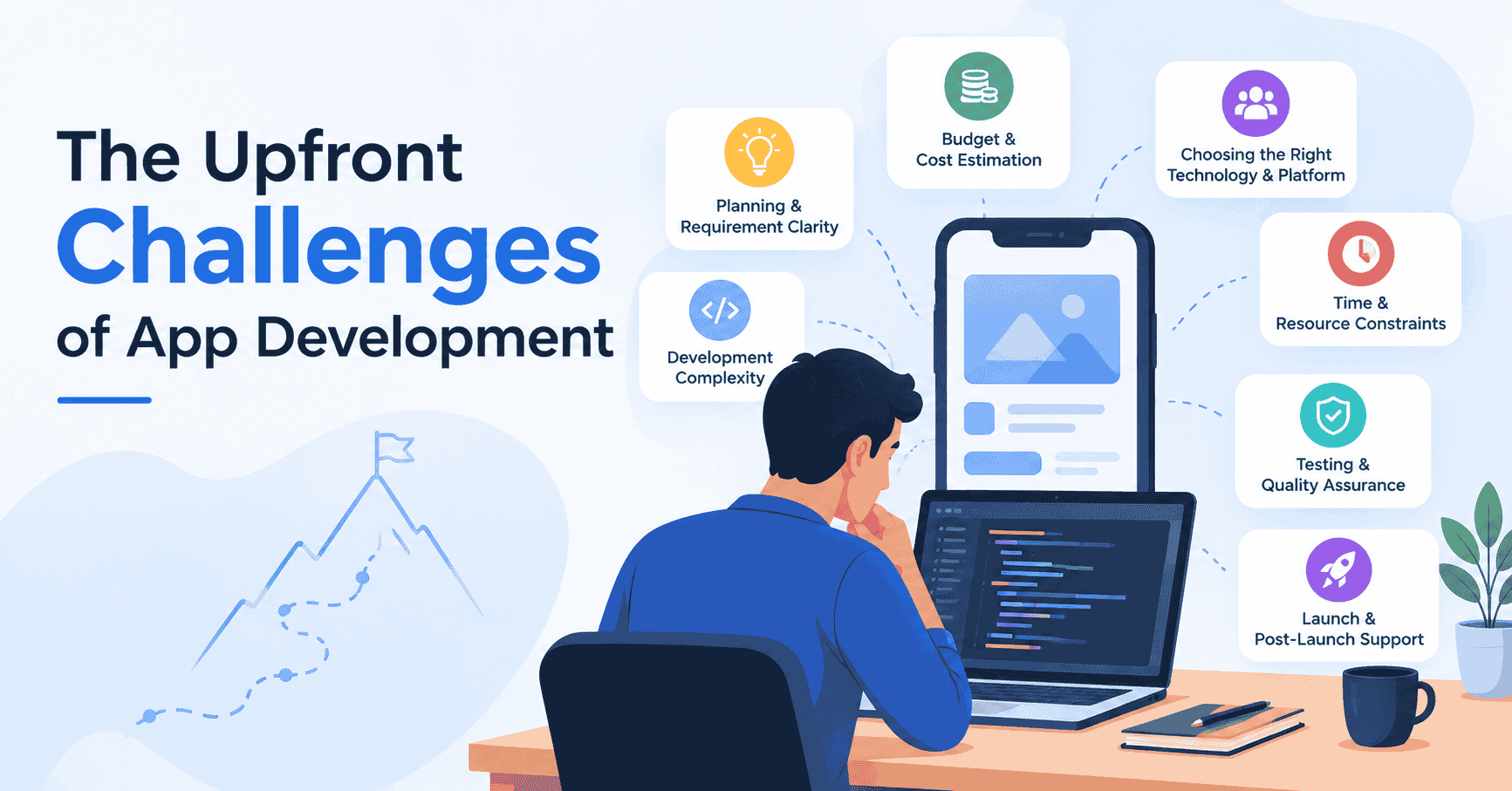
Every successful app you use today, the one that loads instantly, feels intuitive, and rarely crashes, started as a project full of unresolved decisions. Most app failures don’t happen because of bad code; they happen because of avoidable mistakes made before a single line of code was written. If you’re planning a mobile app, understanding these upfront challenges can save your business months of rework and a significant chunk of your budget.
1. Choosing the Right Development Team
The single biggest factor in an app’s success is the team building it, not just their coding ability, but their understanding of your business goals.
Most organizations build two types of apps: customer-facing apps (used by your end users) and employee-facing apps (internal tools). These require very different priorities:
- Customer-facing apps need a project manager who understands both the mobile space and your business objectives, plus designers who prioritize user experience as heavily as developers prioritize functionality.
- Employee-facing apps can tolerate more functional, less polished interfaces since usage is often mandatory.
Common mistake: Treating design as an afterthought. A customer-facing app is a direct reflection of your brand, a clunky interface undermines trust faster than almost any other issue.
2. Native vs. Hybrid vs. Web: Picking the Right Platform
Before development starts, businesses must decide between three core approaches:
| Type | Best For | Trade-off |
|---|---|---|
| Native | Shopping, banking, high-performance apps | Higher cost, longer build time |
| Hybrid | Faster time-to-market, moderate budgets | Slightly reduced performance/consistency |
| Web App | Simple content or MVPs, no install required | Limited access to device hardware/features |
Native apps are generally recommended for customer-facing products because they offer superior speed, deeper hardware integration (camera, GPS, biometrics), and better compatibility with new OS features as they roll out. However, this comes at a higher development cost — a trade-off many enterprises underestimate when budgeting.
The real challenge: Many businesses choose a platform based on cost alone, without mapping it against their actual user expectations and long-term product goals.
3. Waterfall vs. Agile: Choosing a Development Process
Many organizations default to waterfall development — a linear, plan-everything-upfront process — simply because it’s familiar from other types of projects. But customer-facing apps rarely benefit from this approach.
Agile development is better suited to apps that need:
- Frequent updates based on user feedback
- Iterative feature releases rather than one large launch
- The flexibility to adapt to changing market or customer expectations
Apps built on waterfall models tend to feel outdated faster and take longer to fix bugs post-launch, since updates are batched infrequently. Agile teams, by contrast, can respond to real user behavior within weeks rather than months.
4. Resource and Skill Allocation
Customer-facing apps face significantly more complexity than internal tools — and that complexity multiplies across the entire lifecycle: development, deployment, and post-launch support.
Key resourcing challenges include:
- Securing developers and designers with genuinely mobile-specific expertise (not just general software experience)
- Planning for post-launch support, not just the initial build
- Budgeting for iteration — a mobile app is never really “finished”; it evolves continuously with updates, redesigns, and new features
Key Takeaways
| Challenge | Why It Matters |
|---|---|
| Wrong team composition | Leads to poor UX, weak product-market alignment |
| Platform mismatch | Impacts speed, cost, and long-term scalability |
| Wrong development process | Slows down updates and bug fixes |
| Underestimated resourcing | Causes budget overruns and post-launch neglect |
Bottom Line
The biggest risks in app development aren’t technical bugs, they’re strategic decisions made in the first few weeks of planning. Getting the team, platform, and process right upfront determines whether your app becomes a growth engine or a costly liability.