If you are a startup founder or entrepreneur with a brilliant app idea, one of the first questions you will ask is: what is the iOS app development cost? The answer depends on many factors, including app complexity, developer location, design requirements, and ongoing maintenance, but understanding each piece of the puzzle upfront can save you from expensive surprises down the road.
This comprehensive guide walks you through every cost variable involved in building an iOS app, from a simple MVP all the way to enterprise-grade products. By the end, you will have a clear picture of realistic budgets, where the hidden costs hide, and how to make smart financial decisions before writing a single line of code.

Table of Contents
Understanding iOS App Development Costs
Overview of App Development Pricing
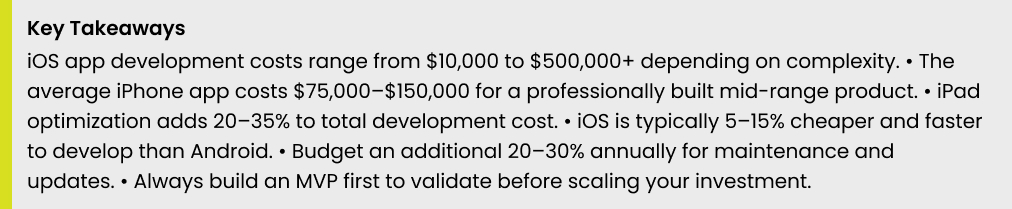
iOS app development cost is not a single number, it is a spectrum shaped by dozens of decisions you make during planning and execution. Industry data consistently shows that the total investment for a professionally built iPhone app can range anywhere from $10,000 to well over $500,000. The enormous range exists because a simple to-do list app and a real-time ride-sharing platform are both “iOS apps” yet have almost nothing in common technically.
The pricing breakdown typically follows three tiers:
- Basic apps (simple UI, 1–3 features): $10,000 – $50,000
- Mid-complexity apps (custom design, backend, social features): $50,000 – $150,000
- Advanced/enterprise apps (AI, real-time data, complex integrations): $150,000 – $500,000+
Key Factors Affecting iOS App Development Cost
Several variables have an outsized impact on how much does it cost to make an Apple app. Understanding them helps you make informed trade-offs:
- App Complexity & Features – More screens and features mean more development hours. Each additional API integration, payment gateway, or real-time feature adds to the bill.
- UI/UX Design Quality – Custom animations and branded design systems cost significantly more than template-based interfaces.
- Backend Infrastructure – Apps that require servers, databases, and APIs for dynamic content add backend development costs on top of front-end work.
- Developer Location & Rate – Hourly rates vary dramatically by geography (see rate comparison table below).
- Testing & Quality Assurance – Thorough QA is non-negotiable for App Store approval and requires dedicated time and budget.
- Third-Party Integrations – Payment processors, analytics SDKs, maps, and push notification services each require integration work.
Importance of Budget Planning for iOS Apps
One of the most common mistakes startups make is treating the development quote as the total budget. In reality, the launch cost is just the beginning. You also need to account for App Store fees, maintenance, updates, server costs, and marketing. A disciplined budget plan accounts for the full product lifecycle, not just the MVP.
Industry benchmarks suggest allocating an additional 20–30% of the initial development cost as an annual maintenance reserve. Proper budget planning reduces the risk of running out of funds mid-development, a situation that can kill a promising product entirely.
Breakdown of Costs by App Type
Cost to Develop an iPhone App
The cost to develop an iPhone app varies based on app category and feature set. Here is a realistic breakdown across common app categories:
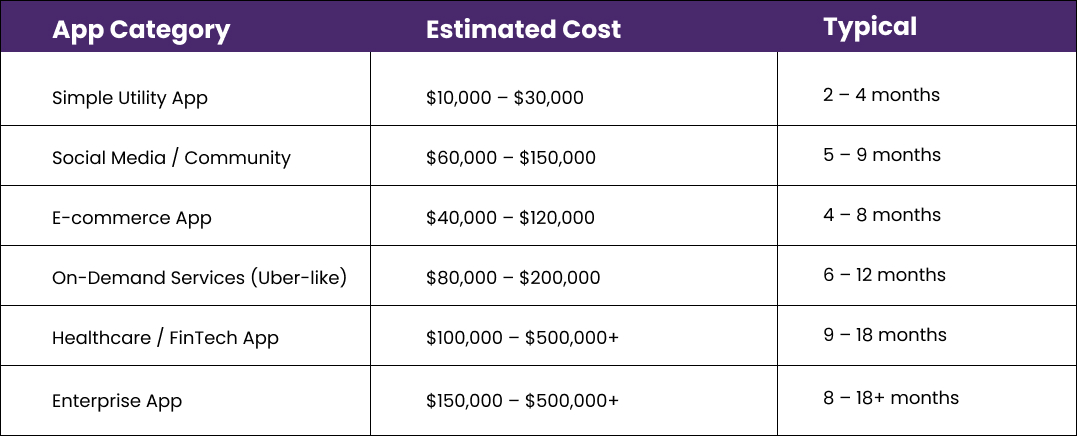
These ranges reflect end-to-end iPhone app development costs including discovery, design, development, testing, and App Store submission. They do not include post-launch maintenance.
iPad App Development Cost Analysis
iPad app development cost is often underestimated by startups who assume an iPhone app automatically scales to iPad. While SwiftUI and modern Apple frameworks make multi-device support easier, optimizing a full-featured app for iPad’s larger screen typically adds 20–35% to the overall development cost. Key considerations include:
- Redesigned layouts that take advantage of the larger canvas
- Split-view and slide-over multitasking support
- Apple Pencil and keyboard shortcut integrations
- iPadOS-specific features like Stage Manager compatibility
For startups, a practical approach is to launch an iPhone-only version first, validate the product, and then invest in an iPad-optimized build in a subsequent release cycle.
Comparing Android and iOS App Development Cost
A common question for startups is whether android and iOS app development cost differently. The short answer: they are comparable, but not identical. IOS development tends to be slightly faster due to a more constrained device ecosystem, Apple controls both hardware and software, reducing fragmentation testing. Android development, by contrast, must account for thousands of device configurations.
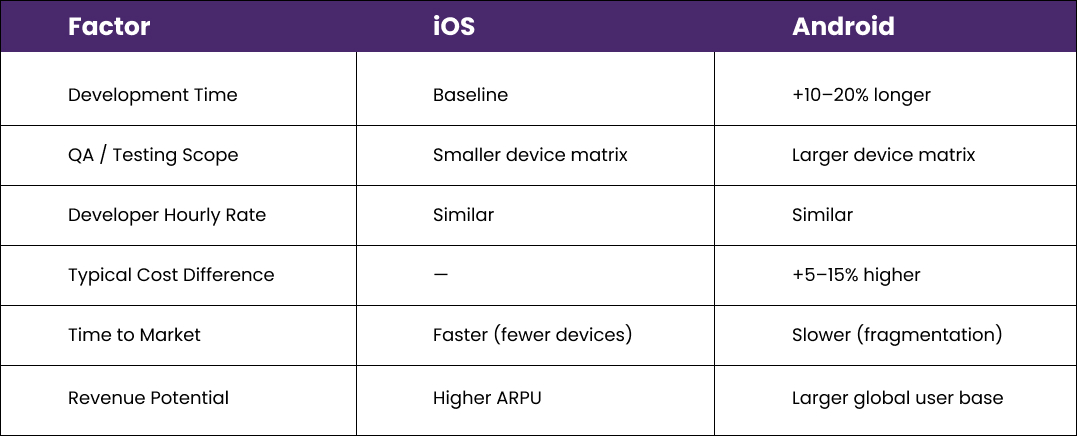
For most startups, launching on iOS first is the standard strategy due to faster time-to-market, higher average revenue per user, and a more streamlined submission process.
iOS App Development Cost in Fresno and Other US Markets
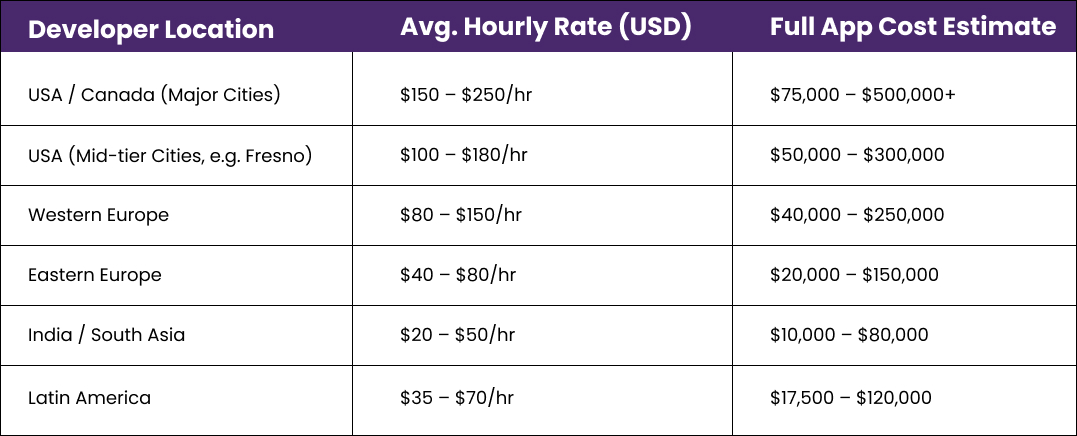
If you are sourcing local talent, iOS app development cost in Fresno and other mid-tier US cities tends to be 20–40% lower than Silicon Valley or New York rates, while still offering the benefit of working within the same time zone and legal framework. Here is how developer rates compare globally:
Estimating your iOS App Development Budget
How to Calculate Mobile App Development Costs
Mobile app development cost estimation starts with a simple formula: Hours × Hourly Rate = Base Development Cost. The critical variable is hours, which you determine through a detailed scoping process. Here is a step-by-step approach:
- Step 1 – List every feature you want in the app, no matter how small.
- Step 2 – Categorize features into Must Have (MVP) and Nice to Have.
- Step 3 – Get developer estimates for each feature in hours.
- Step 4 – Multiply total hours by your developer’s hourly rate.
- Step 5 – Add 20–30% buffer for scope creep and unforeseen complexity.
- Step 6 – Add fixed costs (Apple Developer Program fee, third-party APIs, design tools).
Most startups underestimate step 5, the buffer. Experienced product teams consistently report that projects run 25–40% over initial estimates without proactive scope management.
Common Hidden Costs in iOS App Development
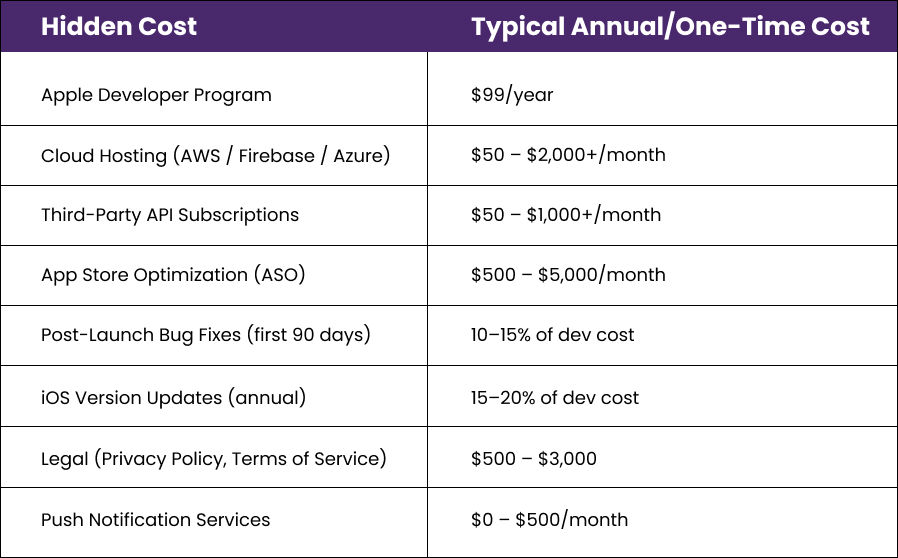
Many first-time app founders are blindsided by costs that were never part of the original quote. Being aware of these upfront allows you to budget more accurately:
Tips for Effective App Development Budgeting
Smart budget management can significantly extend your runway without cutting corners on quality. These strategies are used by experienced product teams:
- Build a lean MVP first – validate the core concept with 3–5 key features before investing in the full vision.
- Use cross-platform frameworks like React Native or Flutter if dual iOS/Android presence is needed, reducing cost by 30–40%.
- Prioritize a fixed-price contract for a well-scoped project to avoid hourly rate overruns.
- Choose an agency or team with App Store submission experience to avoid costly rejection cycles.
- Negotiate a retainer for post-launch support rather than paying ad hoc emergency rates.
- Set aside a dedicated marketing budget, a great app no one discovers is still a failed product.
Future Trends Affecting iOS App Development Costs
Impact of Technology on Development Costs
The iOS development landscape is evolving rapidly, and several emerging technologies are reshaping cost structures, both upward and downward:
- AI-Assisted Development – Tools like GitHub Copilot and AI code generators can reduce boilerplate coding time by 20–30%, potentially lowering costs for standard features. However, AI-specific features (on-device ML, LLM integrations) add complexity and cost.
- SwiftUI Maturity – Apple’s declarative UI framework continues to mature, enabling faster UI development than legacy UI Kit patterns. Startups building new apps in 2024–2026 benefit from faster development cycles.
What factors influence iOS app development cost?
The primary factors are app complexity (number of features and screens), UI/UX design requirements, backend infrastructure needs, developer location and hourly rate, third-party integrations, security and compliance requirements, and post-launch support scope. The more custom and feature-rich the app, the higher the cost.
How do you estimate mobile app development costs?
The most reliable estimation method is to scope each feature individually, get hour-by-hour estimates from your development team, apply an hourly rate based on developer geography, and add a 20–30% contingency buffer. Always request detailed, itemized quotes — vague “ballpark” figures from developers are a red flag.
Is there a difference in cost for iPad and iPhone apps?
Yes. A dedicated iPad-optimized experience typically adds 20–35% to development cost compared to an iPhone-only app. This is because iPad layouts require separate design decisions, support for multitasking modes, and additional QA across screen sizes. Most startups launch iPhone-first and add iPad optimization in version 2 or 3.
How do you know how much an app costs on iPhone?
You can estimate iOS app costs by requesting proposals from at least three development agencies, using cost calculators from platforms like Clutch or Good Firms, and benchmarking against publicly available case studies. The most accurate estimate will always come from a paid discovery phase with your chosen development partner, where requirements are defined in detail before committing to a fixed price.
- VisionOS & Spatial Computing – Apple Vision Pro introduces an entirely new app category. Early adopters building spatial apps face premium development costs given the nascent tooling and developer pool.
- Privacy Regulations – Increasing compliance requirements (GDPR, CCPA, App Store privacy nutrition labels) add legal review and development overhead to every project.
- No-Code / Low-Code Platforms – For very simple apps, platforms like Bubble or Adalo can deliver MVPs at $5,000–$20,000, dramatically undercutting traditional development – though with significant customization limitations.
Frequently Asked Questions (FAQ)
What factors influence iOS app development cost?
The primary factors are app complexity (number of features and screens), UI/UX design requirements, backend infrastructure needs, developer location and hourly rate, third-party integrations, security and compliance requirements, and post-launch support scope. The more custom and feature-rich the app, the higher the cost.
How do you estimate mobile app development costs?
The most reliable estimation method is to scope each feature individually, get hour-by-hour estimates from your development team, apply an hourly rate based on developer geography, and add a 20–30% contingency buffer. Always request detailed, itemized quotes – vague “ballpark” figures from developers are a red flag.
Is there a difference in cost for iPad and iPhone apps?
Yes. A dedicated iPad-optimized experience typically adds 20–35% to development cost compared to an iPhone-only app. This is because iPad layouts require separate design decisions, support for multitasking modes, and additional QA across screen sizes. Most startups launch iPhone-first and add iPad optimization in version 2 or 3.
How do you know how much an app costs on iPhone?
You can estimate iOS app costs by requesting proposals from at least three development agencies, using cost calculators from platforms like Clutch or Good Firms, and benchmarking against publicly available case studies. The most accurate estimate will always come from a paid discovery phase with your chosen development partner, where requirements are defined in detail before committing to a fixed price.
Final Thoughts: Is the iOS App Development Cost Worth It?
For most startups, yes, but only if you approach the investment strategically. The iOS app development cost is significant, but so is the opportunity: the App Store generates billions in developer revenue annually, and iOS users consistently demonstrate higher spending behavior than any other mobile platform.
The key is to start lean. Build a focused MVP, validate your concept with real users, and use early revenue or investor feedback to fund subsequent development phases. Trying to build a fully featured product on a startup budget before validating the market is the most common, and most expensive, mistake founders make.
Use the cost frameworks in this guide to have informed conversations with potential development partners, and always get itemized, written estimates before signing any contracts.